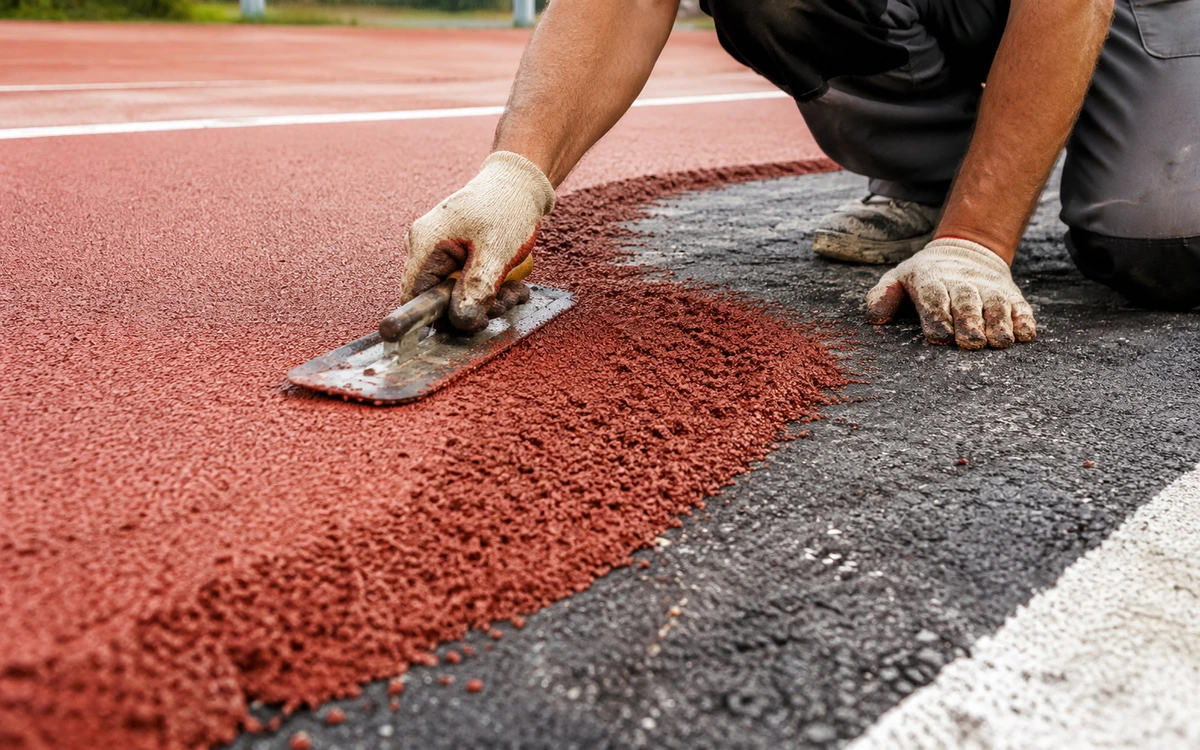
We provide professional running track resurfacing services in Portsmouth, VA for cracked asphalt, worn synthetic surfaces, fading lanes, and uneven track areas that reduce safety and performance. Resurfacing, patching, and recoating rebuild the running surface, restore traction and shock absorption, and create a uniform, durable finish that improves safety and prevents further surface breakdown. Request a quote today.
Why Does Running Track Surface Crack or Peel Over Time?
Running track surfaces crack and peel because the polyurethane top layer breaks down under UV exposure, water intrusion, and repeated athletic impact. Temperature swings cause the asphalt or concrete base to expand and contract, weakening the bond layer. Over time, the rubber granules and seal coat lose elasticity and start separating.
How Do Coastal Weather Conditions Affect Running Tracks in Portsmouth Virginia?
Portsmouth’s coastal humidity and seasonal storms can gradually weaken the bonding layers in running tracks. School stadiums near the waterfront often show drainage stress and surface softening. Resurfacing helps restore a sealed, even surface for reliable athletic use.
When Does a Running Track Need Resurfacing Instead of Patch Repair?
A running track needs resurfacing when damage is widespread and patch repairs no longer bond cleanly to the existing surface. If you see multiple worn lanes, exposed base, or recurring seam failure, the system has reached end-of-life. At that stage, full resurfacing restores uniform traction and structural integrity.
How Long Does a Resurfaced Running Track Typically Last?
A properly resurfaced running track typically lasts 8 to 15 years depending on usage intensity and climate conditions. High-traffic school or collegiate tracks wear faster due to constant spikes and training volume. Regular cleaning and UV-stable coatings help extend surface performance.
What Is the Difference Between Polyurethane Resurfacing and Full Track Replacement?
Polyurethane resurfacing restores the top system by adding new rubber and binder layers over a sound base, while full replacement rebuilds the entire track structure from asphalt or concrete up. Resurfacing preserves the existing foundation, but replacement is required when the base has failed or shifted. The choice depends on structural stability beneath the surface.
Can a Running Track Be Resurfaced After Water Damage or Base Shifting?
A running track can be resurfaced after water damage only if the underlying base has not been permanently compromised. If the asphalt has softened, cracked deeply, or shifted, resurfacing alone will not hold. Proper drainage correction and base stabilization are required before applying new layers.
What Are Signs a Running Track Surface Is Unsafe or Non-compliant for Athletes?
A running track is unsafe when the surface becomes uneven, slippery, or has exposed aggregate that reduces traction. Visible seam separation, pooled water, and hard brittle zones indicate the system is failing. These conditions increase injury risk and usually mean the track is beyond maintenance-level repair.
How Much Does Running Track Resurfacing Cost in Portsmouth, VA?
Running track resurfacing costs in Portsmouth, VA typically range between $19,312 and $49,888, with typical pricing depending on track size, the condition of the existing surface, the amount of crack repair required, and the type and thickness of the resurfacing system being applied. Pricing can also vary based on surface preparation requirements, striping and marking restoration, drainage-related repairs, accessibility of the site, and whether localized structural or base repairs are needed before resurfacing.